
Aerosol Fire Extinguisher RFQ: Mounting, Activation, Evidence, and Packaging

An aerosol fire extinguisher RFQ for an electrical cabinet should describe the protected enclosure, mounting interface, activation arrangement, required evidence, quantity, destination, and acceptance process before a supplier quotes a model. A short request such as “send your smallest automatic unit” transfers critical engineering decisions to the seller and makes competing quotations impossible to compare. A useful request for quotation separates known requirements from assumptions and identifies every item that must be confirmed during sample approval.

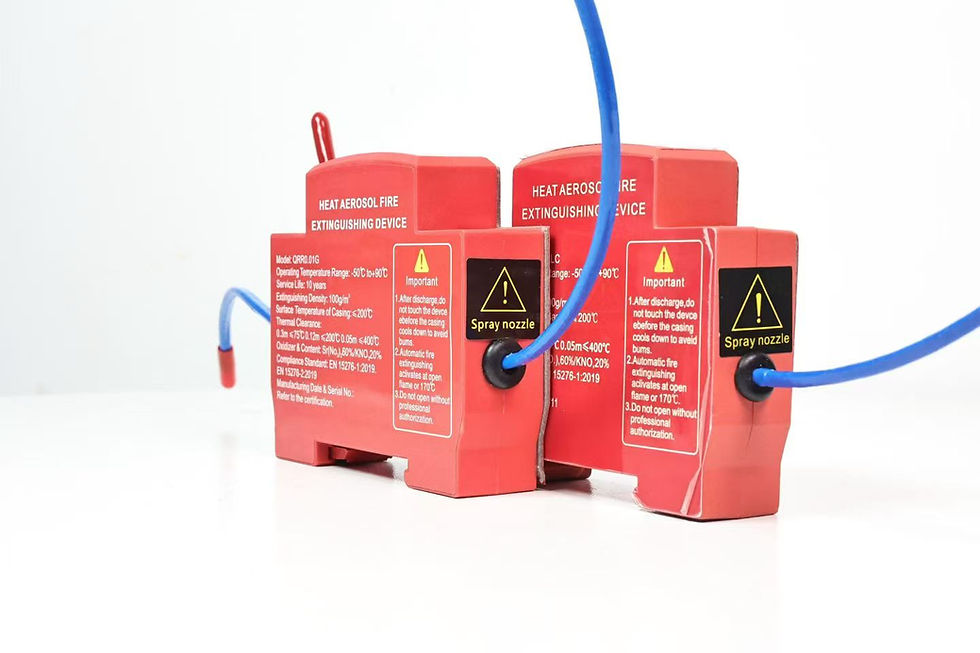
The production image used with this guide shows compact red device housings and activation leads in a manufacturing fixture. It supports discussion of configuration control only. It does not prove a protection volume, activation temperature, service life, certification, or successful fire test. Those claims require model-specific documentation that matches the ordered configuration.
Start with the enclosure and fire-protection objective
Identify the equipment being protected: MCB distribution box, switchgear compartment, control panel, meter box, solar combiner box, inverter cabinet, EV charger cabinet, telecom cabinet, or another enclosed electrical assembly. Provide internal dimensions, free volume after equipment is installed, partitions, vents, fans, cable openings, door seals, normal temperature range, expected contamination, and maintenance access.
State the protection objective without promising an outcome that has not been validated. For example, the project may seek automatic response to a developing cabinet fire, local protection of a defined compartment, alarm initiation, power isolation, or reduction of escalation risk. Whether a particular device and arrangement can meet that objective depends on application testing, installation, approvals, and coordination with the enclosure.
ISO 15779:2026 addresses requirements and test methods for components and system design, installation, testing, maintenance, and safety of condensed aerosol systems. Its public scope also states that local applications require a pre-engineered and pre-designed system tested and approved for the specific application by a relevant authority. Referencing the standard in an RFQ is therefore a request for applicable evidence, not a statement that an offered unit is certified.
ANSI/CAN/UL/ULC 2775 covers the construction and operation of fixed condensed aerosol extinguishing system units within its stated scope. A buyer should ask whether a quotation relies on this or another requirement, which exact model and revision the evidence covers, which installation conditions apply, and who issued the report. Do not accept a standard number printed on a label as sufficient proof.
Define one protected compartment per RFQ line
Use a separate line for each enclosure family that changes volume, openings, airflow, hazard, installation geometry, or environmental condition. Record:
Cabinet type, drawing number, revision, internal dimensions, and net free volume calculation.
Equipment layout, partitions, cable ducts, obstructions, and likely ignition locations.
Door, gasket, ventilation opening, fan, filter, drain, and cable-entry condition.
Normal and maximum credible operating temperatures, including solar gain or fan failure where relevant.
Power system, isolation strategy, alarm requirement, restart logic, and service access.
Installation orientation, available mounting surfaces or rail, clearance envelope, and permitted fasteners.
Destination country, responsible designer, authority having jurisdiction, and required third-party evidence.
If drawings are confidential, provide a controlled redacted layout and dimensional interface. A quotation based only on an exterior photograph cannot establish mounting fit, discharge path, or activation-element routing.
Specify the mounting option as an interface
The words clip-on, DIN rail, and adhesive describe different mechanical interfaces, not cosmetic options. Give each one a separate part number or option code.
For clip-on or snap-fit mounting, provide the mating feature, material, thickness, receiving geometry, allowable tolerances, installation direction, retention objective, removal method, cable-load condition, vibration environment, and service-cycle expectation. The clip-on mounting guide explains how to convert those inputs into fit and retention checks.
For DIN rail mounting, provide the rail profile and drawing, available rail length, adjacent devices, end stops, orientation, anti-slide requirement, installation tool clearance, and removal access. Do not write “35 mm DIN rail” unless the actual rail and product interface are confirmed. Use the DIN rail installation guide to define the sample fixture and inspection record.
For adhesive or self-adhesive mounting, identify the substrate, coating, roughness, cleanliness, temperature, humidity, curvature, surface-preparation method, application pressure, cure or dwell condition, cable pull, aging exposure, and replacement method. Name an adhesive brand only when the supplied material and authorization are verified. The adhesive mounting qualification guide provides a structured surface and peel-check plan.
Describe activation and cause-and-effect behavior
Ask the supplier to identify the offered activation method, interfaces, routing restrictions, permitted tests, supervision method, and replacement condition. Distinguish a thermal activation element from an electrical release circuit, alarm contact, remote indication, and cabinet shutdown logic. The RFQ should not assume that one component performs every function.
Provide a cause-and-effect table showing the initiating condition, alarm, power isolation, fan shutdown, damper response, external signal, event record, manual reset, and restart authorization. Ask which functions are part of the offered device and which require project equipment. Require a safe non-discharge commissioning method. Never request an improvised heating, continuity, flame, or activation test on a live device.
Use a comparable RFQ data sheet
Send every bidder the same table:
RFQ field: Application; Buyer input: Cabinet type, compartment, hazard and objective; Supplier response and evidence: Proposed model and application boundary
RFQ field: Enclosure; Buyer input: Drawing, net volume, openings, airflow and temperature; Supplier response and evidence: Required limits and unresolved assumptions
RFQ field: Mounting; Buyer input: Clip-on, DIN rail or adhesive interface drawing; Supplier response and evidence: Bracket, materials, dimensions and installation instructions
RFQ field: Activation; Buyer input: Required detection/release and cause-and-effect; Supplier response and evidence: Offered method, interfaces and non-discharge test
RFQ field: Evidence; Buyer input: Destination requirements and requested standards; Supplier response and evidence: Model-specific reports, issuer, revision and limitations
RFQ field: Traceability; Buyer input: Required lot or serial relationship; Supplier response and evidence: Production date, lot code, release record and retained data
RFQ field: Packaging; Buyer input: Handling, shipment and storage conditions; Supplier response and evidence: Restraint, lead protection, labels and carton identification
RFQ field: Commercial; Buyer input: Samples, pilot quantity, annual estimate and schedule; Supplier response and evidence: MOQ, lead time, price basis, tooling and option charges
RFQ field: Change control; Buyer input: Buyer approval before critical change; Supplier response and evidence: PCN scope, notice period and first changed lot
Blank fields should become written assumptions, not silent guesses. Ask suppliers to mark included, optional, excluded, and pending items. This makes technical and commercial gaps visible before price comparison.
Request an evidence index rather than a certificate bundle
For each claim, require an evidence index with document title, number, revision, date, model, configuration, test sample, issuing organization, applicable clause, result, limitations, and buyer review status. Check that the report covers the offered housing, extinguishing configuration, activation method, mounting option, and intended application boundary.
Separate five evidence types: product drawing, manufacturer verification, witnessed test, independent laboratory report, and third-party certification or listing. They answer different questions. A supplier declaration cannot be presented as an independent approval, and an unrelated family report cannot automatically cover a changed model.
The SUNIOIO sample-approval guide describes how to freeze the approved unit, drawings, markings, instructions, and packaging. The factory-audit checklist then checks whether production can repeatedly deliver that definition.
Include packaging, labeling, and receiving requirements
Define how the housing, mounting part, activation lead, label, and accessories must be restrained and protected. Request inner-pack orientation, lead bend protection, separation from sharp carton features, moisture and contamination control, quantity per carton, carton mass, lot identification, packing list relationship, pallet pattern where used, and handling marks justified by the shipment.
Ask for label artwork and language before samples. The label should identify the model and traceable production information required by the approved design. Avoid unsupported absolute statements. Require carton and device identities to agree with the purchase order, golden sample, drawing, and release record.
The incoming-inspection plan should define identity checks, visual damage, mounting fit, critical dimensions, permitted non-discharge checks, document review, sample size, defect classification, lot disposition, retained samples, and escalation. Packaging approval is not complete until the buyer can connect a received unit to the approved configuration and shipment records.
Commercial terms that prevent technical ambiguity
Request separate prices for each mounting variant, sample quantity, pilot quantity, and volume tier. Identify whether quotations include mounting parts, activation components, labels, instructions, testing documents, packaging, tooling, freight, duties, and destination-specific approvals. State quotation validity, production lead time, sample lead time, payment terms, warranty evidence requirements, spare or replacement policy, and complaint-response expectations.
Require written product change notification before changes to formulation, critical materials, housing, mounting hardware, activation elements, conductors, adhesive, suppliers, factory, tooling, process, test method, label, or packaging. The supplier should identify the first changed lot and provide risk review and validation evidence before implementation.
Bid evaluation and release gates
Score offers in separate columns for application fit, mounting definition, activation integration, evidence traceability, sample plan, production control, packaging, service, commercial terms, and unresolved risk. Do not average away a critical safety or compliance gap with a low price.
Use these release gates:
RFQ assumptions reviewed and closed.
Model, mounting option, drawings, and evidence index accepted for sample build.
Production-representative sample inspected against the target cabinet.
Required qualification and application tests completed under approved procedures.
Golden sample, documentation, label, and packaging frozen.
Pilot or first-article lot passes receiving and installation checks.
PCN, traceability, complaint, and repeat-order controls enter the purchase agreement.
Frequently asked questions
What information should be sent before asking for an aerosol fire extinguisher quotation?
Send the cabinet drawing, protected compartment, net free volume, openings, airflow, normal temperatures, hazard objective, mounting interface, activation and alarm requirements, destination, evidence expectations, quantity, and schedule.
Can one quotation cover clip-on, DIN rail, and adhesive mounting?
The commercial document can include all three, but each mounting method should have its own option code, interface drawing, sample, inspection method, packaging identity, and price because the field risks and validation evidence differ.
Does reference to ISO 15779 or UL 2775 prove certification?
No. A reference identifies a possible evidence framework. The buyer must verify the exact model, edition, configuration, report or listing, issuing body, scope, limitations, and applicability to the intended enclosure.
Should the lowest quoted unit price determine the supplier?
No. Compare the complete delivered scope, application assumptions, evidence, tooling, packaging, change control, service support, and cost of unresolved risk. An incomplete low price can be more expensive after sample rejection or field rework.
Contact SUNIOIO
For electrical cabinet aerosol fire extinguisher RFQs, mounting options, OEM samples, drawings, evidence review, and quotation support, contact SUNIOIO / Yueqing Zhaoqing Electric Co., Ltd.
Phone / WhatsApp / WeChat: +86 13588953026
Website: https://www.sunioio.com/ | Send an inquiry


留言