
OEM Aerosol Fire Extinguisher Sample Approval for Electrical Cabinets

An OEM sample of a compact aerosol fire extinguisher is not approved when its color, logo, and basic fit look acceptable. Approval means the buyer and supplier have agreed on one controlled configuration, its intended electrical-enclosure application, the evidence supporting that application, and the tests that the first production lot must pass. Without that baseline, a later change in the generator, activator, bracket, adhesive, label, or instructions can make a visually identical shipment a different product.
This guide is for distributors, panel builders, and private-label buyers evaluating a micro aerosol fire suppression device for a small electrical cabinet. It gives a sample-approval record that can be completed and signed. It does not claim that any specific SUNIOIO model is certified, listed, or suitable for a given hazard. Final selection must follow model-specific documents, independent evidence where required, and the destination market's approval process.
Start with an Application Brief, Not a Logo File
The buyer should describe what the device is expected to protect. Record the cabinet drawing, internal dimensions, openings, ventilation state, electrical equipment, ambient conditions, operating access, and whether the cabinet can remain energized after activation. A sample selected for a sealed control box cannot automatically become the production standard for a ventilated inverter cabinet.
Define the proposed function precisely. Is the product a stand-alone automatic extinguisher unit, a component of a larger fixed system, or a pre-engineered device for a specific enclosure family? What fire hazard and enclosure conditions were included in the submitted test or design evidence? ISO 15779:2026 covers condensed aerosol system components and recommendations for design, installation, testing, maintenance, and safety. Its public scope distinguishes total-flooding systems from local applications; local applications require a pre-engineered, pre-designed system tested and approved for the specific use. The buyer should therefore request the actual scope, not assume a generic volume claim applies everywhere.
The application brief should also state the regulatory destination and the authority that will review the installation. A standard reference in a catalog is not a certificate. UL Solutions identifies ANSI/CAN/UL/ULC 2775 as a standard for fixed condensed aerosol extinguishing system units and explains that test programs depend on product type and application. Ask for a report, listing record, or declaration only where one actually exists, then check model number, edition, configuration, and limitations. Never put a certification mark on private-label artwork without written authorization and the matching controlled evidence.
Freeze the Complete OEM Configuration
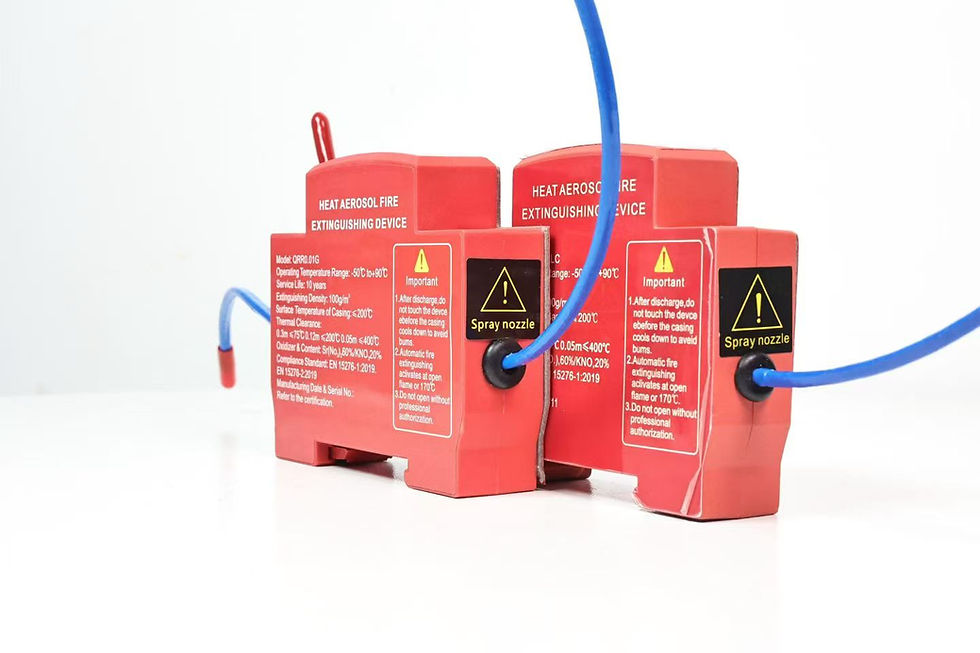
A reliable sample code covers more than the red housing. It should identify the generator body, extinguishing composition reference, activator type, sensor or thermal element, cable and connector, mounting hardware, warning labels, operating instructions, and packaging. If the order includes several mounting options, each option needs its own controlled configuration or an explicitly approved family definition.
Clip-on mounting depends on the mating profile and retention direction. DIN rail mounting depends on rail compatibility, locking geometry, neighboring component clearance, and removal access. Adhesive mounting depends on the substrate, coating, surface preparation, adhesive system, cure process, aging, and service environment. These are performance-relevant differences. An unapproved substitution from a clip to adhesive, or from one adhesive to another, is not a cosmetic change.
The supplier should assign a drawing and revision to each critical item. The buyer should retain a signed golden sample and a digital package containing the bill of materials, assembly drawing, dimensions, label artwork, instructions, test plan, and approved deviations. A photograph is useful for orientation but cannot establish hidden component identity or prove that the sample came from the actual production process.
Use a Two-Level Evidence Review
First review the product-level evidence: model datasheet, operating and storage conditions, activation method, installation instructions, service-life statement, warnings, and any independent test or certification documents. Then review application evidence: calculation or selection method, enclosure boundary, openings, placement, ventilation logic, mounting orientation, discharge clearance, and intended hazard. The second level cannot be replaced by a product brochure.
Where evidence is partial, record the boundary explicitly. For example, a report for one enclosure volume may not cover a larger box; a vibration test of a DIN-rail bracket does not prove adhesive retention; and a thermal activation demonstration does not prove electrical isolation. The sample record should have a field for "not verified" rather than forcing every row to pass. Unresolved safety-critical rows are hold points, not commercial negotiation items.
OEM Sample Approval Matrix
Use one matrix per product configuration and enclosure application. Attach the evidence document identifier and revision beside every pass decision.
Review area | Evidence to retain | Approval decision Product identity | Model, revision, lot, photographs, physical marking | Matches approved sample or hold Intended application | Cabinet drawing, hazard, volume, openings, environment | Within documented design scope or hold Generator and activator | Controlled parts list, routing drawing, instructions | Exact approved construction or hold Mounting option | Clip, DIN rail, or adhesive assembly drawing and test basis | Mechanically suitable and serviceable or hold Electrical interface | Voltage, current, supervision, alarm and trip logic where applicable | Functional test matches cause-and-effect record or hold Discharge location | Orientation, keep-out zone, obstructions, access | Matches approved placement drawing or hold Labels and language | Warning text, model identification, date or lot code, destination language | Legible and legally reviewed or hold Evidence claims | Report number, standard edition, product scope, mark authorization | Every public claim supported or remove claim Packaging | Pack specification, quantity, protection, traceability | Survives agreed distribution route or redesign Change control | Revision owner, notification rule, reapproval trigger | Written process accepted or hold
The matrix is deliberately binary at the hold point. A buyer may authorize a conditional pilot for noncritical issues, but the condition, owner, deadline, and allowed quantity must be documented. Do not write "pass" because the supplier promises to send missing evidence later.
Separate Functional Checks from Discharge Testing
Incoming sample inspection can verify dimensions, finish, labeling, mounting retention, connector pinout, thermal-element routing, and accessibility. Where the selected system has an alarm, monitoring output, or trip interface, use the manufacturer's approved non-discharge test method to check the cause-and-effect sequence. Do not trigger a live generator in an occupied or energized cabinet simply to demonstrate that it fires.
If application approval requires a discharge test, commission a controlled plan with competent personnel, a representative enclosure, instrumentation, acceptance criteria, post-test inspection, and a defined number of samples. The report should identify the exact configuration and test boundary. A video of one successful discharge is not a substitute for that report, and one report should not be used to claim universal performance for different enclosure families.
The receiving checklist should also check the storage and handling state of the sample. Verify seals, packaging, transport damage, date or lot markings, and instructions. Ask the supplier what constitutes a damaged or expired unit and how a suspect sample is quarantined. The buyer should not infer unlimited service life or a maintenance-free status from the absence of a pressure gauge.
Approve the Production Process, Not a Hand-Built Prototype
A hand-assembled show sample may have careful cable routing and perfect labels that normal production cannot repeat. Approve samples taken from the intended production process, with the same tooling, purchased components, inspection points, packaging, and traceability method planned for mass orders. Record the sample lot and retain both buyer and supplier references.
For the first production lot, compare critical attributes with the golden sample. Check the controlled bill of materials, activator position, mounting hardware, orientation marks, label text, warning symbols, packaging materials, and document revision. Use a risk-based sampling plan for measurements and functional checks. A cosmetic color variation may be negotiable; a changed activator, composition, adhesive, or discharge geometry should trigger formal engineering review.
Change control needs named triggers. Require written notice before changing a critical material, supplier, process, mold, firmware or electronic interface, mounting system, test method, label claim, or packaging structure. The notice should explain the change, affected lots, equivalence evidence, and whether requalification is needed. The buyer then signs an approval or rejection before production shipment.
Packaging and Transport Are Part of the Sample
The packaging must protect the device and preserve traceability through the actual distribution route. Record unit packaging, inner protection, carton quantity, pallet or parcel mode, humidity exposure, temperature limits, orientation marks, and handling warnings. A loose thermal element or broken clip arriving at the customer is not merely a packaging defect; it can prevent correct installation.
Select a transport test based on the shipment method. ISTA explains that its 1-Series are screening tests, while 3-Series procedures simulate damage-producing motions and conditions for defined distribution environments. Choose a procedure that matches the real route and the packaged-product format; do not claim "ISTA certified" because a single informal drop was performed. The test report should state the pack configuration, conditioning, sequence, inspection method, and pass/fail criteria.
After transport simulation, recheck labels, mounting features, activation components, electrical interfaces where present, and physical damage. The sample should remain installable according to the approved instructions. If packaging is revised, repeat the relevant checks before releasing a large shipment.
Buyer Questions That Reveal Supplier Readiness
Ask the supplier to show the controlled model and configuration list, not just a price table. Request an example traceability record linking a finished unit to component lots and test results. Ask who approves substitutions and how buyers are notified. Ask how returned or damaged units are quarantined. Ask whether installation instructions cover each mounting option separately. Ask which evidence supports the advertised application and which configurations are outside scope.
For private label orders, confirm who owns the artwork and who authorizes every performance or certification statement. Remove claims that cannot be tied to a model-specific document. The technical file supplied with a quoted product should be the same file used when the production lot is accepted. A factory tour or attractive sample is helpful context, but it is not a substitute for controlled records.
To define cabinet conditions before supplier quotation, use the small enclosure volume and leakage worksheet. For a particular electrical-panel layout, review the MCB distribution box application guide. The adhesive mounting qualification guide is relevant when the OEM option uses a bonded installation.
Frequently Asked Questions
Can I approve an OEM aerosol extinguisher from one sample photograph?
No. The photograph cannot establish hidden components, application evidence, activation performance, mounting retention, lot traceability, or production repeatability. Approve a controlled physical sample and revisioned documentation together.
Should clip-on, DIN-rail, and adhesive versions share one part number?
Only if the configuration control clearly identifies each variant and the evidence covers all of them. Separate part numbers or suffixes are usually easier for purchase orders, incoming inspection, installation instructions, and change control.
Does a reference to ISO 15779 or UL 2775 mean the product is certified?
No. A standard citation identifies a possible evaluation framework. Certification or listing is a separate claim that requires a valid document or database record for the exact model and configuration, plus authorization to use any mark.
What should be checked on the first production lot?
Compare the lot against the approved bill of materials, golden sample, mounting components, activator arrangement, labels, instructions, packaging, and traceability records. Perform the agreed functional and dimensional tests, close deviations, and retain the lot-specific acceptance record.
Authoritative References
ISO 15779:2026, Condensed aerosol fire extinguishing systems UL fire-extinguishing system unit testing and ANSI/CAN/UL/ULC 2775 ISTA test procedures and their intended distribution uses
Contact SUNIOIO
Send an application brief, cabinet drawing, mounting preference, destination market, target quantity, and required evidence package through the SUNIOIO contact page. Explore our electrical product and OEM services.
SUNIOIO / Yueqing Zhaoqing Electric Co., Ltd. Phone / WhatsApp / WeChat: +86 13588953026 Visit SUNIOIO | Send an inquiry


留言