
Aerosol Fire Extinguisher Factory Audit: Evidence and Change-Control Checklist

A factory audit for electrical-cabinet aerosol fire extinguishers should establish whether the supplier can repeatedly build the approved configuration, detect nonconforming product, preserve lot identity, and notify the buyer before a change affects fit, activation, installation, or performance. A tour of equipment and a certificate folder are not enough. The audit needs traceable evidence from incoming material through assembly, inspection, release, packaging, complaint handling, and engineering change control.

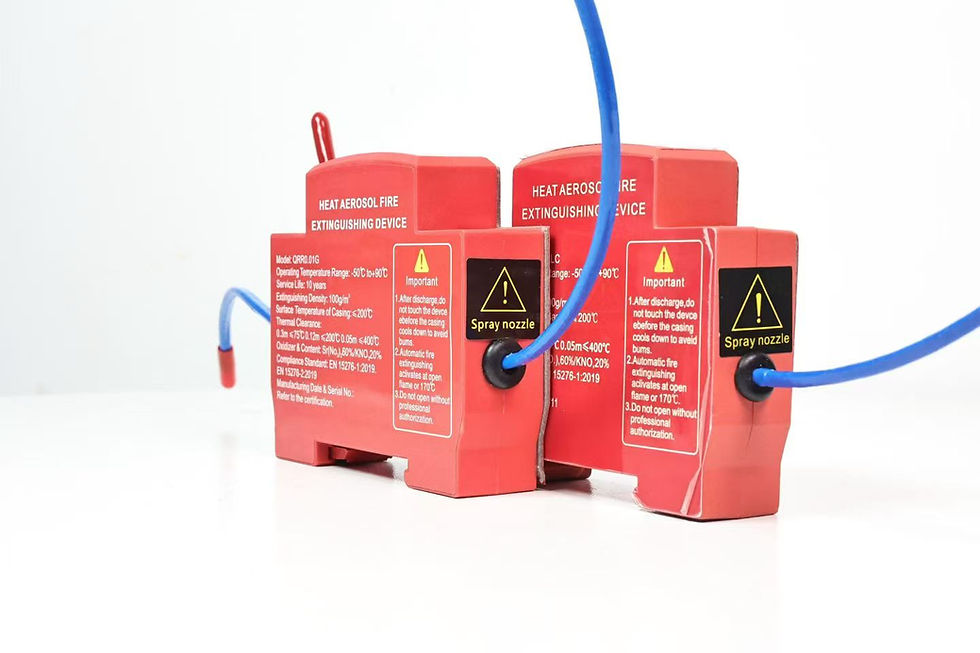
The product-batch image in this guide shows compact devices during production handling. It documents the general product form only; it does not prove a specific capacity, certification, protection volume, or test result. Those claims require model-specific drawings, reports, and approval for the destination market.
Begin with the approved product definition
Before visiting a China aerosol fire extinguisher manufacturer, freeze the unit that the audit will evaluate. The definition should include the exact model, enclosure application, installation method, activation arrangement, external dimensions, mass, cable or thermal-cord routing, labels, packaging, and revision status. If clip-on, DIN rail, and adhesive-backed variants are offered, treat their brackets, interfaces, and installation instructions as separate controlled configurations.
Use the SUNIOIO OEM sample-approval guide to establish a golden sample and evidence package before volume release. The audit should then prove that purchasing, work instructions, inspection records, and finished units all point to that same approved definition.
Ask the supplier to identify every characteristic that can change installation or function. Typical items include housing geometry, mounting clip, rail interface, adhesive specification, fasteners, activation element, conductor length, terminal treatment, markings, manufacturing date or lot code, internal formulation control, sealing process, and protective packaging. This is a risk list, not permission to infer confidential formulation details or unverified performance.
Separate system standards from product claims
ISO 15779:2026 specifies requirements and test methods for condensed aerosol fire-extinguishing systems. Its scope is useful when building an evidence request, but mentioning the standard does not mean a product is certified or suitable for every cabinet. Local applications, system design, installation, safety provisions, and required approvals still need project-specific review.
ISO 19011:2026 provides guidance for auditing management systems. Use its principles to plan evidence sampling, auditor competence, audit trails, findings, and follow-up. Do not convert a management-system audit into an unsupported product-safety claim. A buyer should distinguish a process-control finding from witnessed product performance and from third-party certification.
Factory audit evidence map
Build the audit around records that connect one shipment to the approved design:
Contract review: inquiry, application, destination, model, mounting method, evidence requirements, labels, quantity, and buyer-approved exceptions.
Design control: current drawings, bill of materials, specifications, risk review, verification plan, approval signatures, and revision history.
Incoming control: supplier identity, material or component specification, certificate review where relevant, sampling plan, inspection result, quarantine, and nonconformance disposition.
Production control: controlled work instructions, trained operators, defined process parameters, approved tools, in-process checks, and recorded deviations.
Final release: model identity, dimensions, mounting fit, activation-interface checks that do not require discharge, markings, appearance, quantity, lot code, and authorized release.
Traceability: finished serial or lot number linked to material lots, production date, operator or line, inspection result, approved revision, and shipment.
Packaging: restraint of the device and leads, moisture and contamination protection, label protection, quantity verification, carton identification, and shipment records.
Post-market control: complaint intake, containment, returned-unit analysis, root cause, corrective action, effectiveness check, and communication to affected buyers.
The auditor should select records from the floor and trace them backward and forward. Start with a finished carton, find its release record and material identity, then confirm that the record uses the current drawing. Start with a quarantined component and verify that it could not be issued to production. Prepared showcase folders are helpful, but random trace exercises reveal whether the system works in normal production.
Audit three mounting variants independently
A DIN rail aerosol fire extinguisher manufacturer may share the same main device across variants, yet the installation interface changes the field risk. Audit each supplied mounting method.
For clip-on or snap-fit mounting, examine the controlled receiving geometry, material identification, molding or forming inspection, retention check, cable-pull influence, removal method, and tolerance stack. The buyer should specify the mating cabinet feature. The clip-on mounting guide explains why retention and service access must be verified with production-representative parts.
For DIN rail mounting, check the actual rail profile claimed in the specification, latch engagement, anti-slide feature, adjacent-device clearance, assembly orientation, and removal access. Do not write “35 mm DIN rail” unless the product drawing and test fixture confirm that interface. Review the DIN rail installation guide when defining the audit fixture and cabinet drawing.
For adhesive mounting, inspect adhesive identity, shelf-life control, storage conditions, lot recording, surface-preparation instructions, application pressure, cure or dwell requirements, and packaging that prevents contamination. A brand name should appear only when the supplied material and authorization are verified. The adhesive mounting qualification guide provides a surface-preparation and acceptance framework.
Sample the process, not only the finished appearance
Choose at least one active or recently completed order and follow its actual route. Confirm that operators can access the current work instruction at the station and that obsolete copies are controlled. Compare recorded checks with physical gauges and test fixtures. Ask how a failed check is recorded, segregated, investigated, reworked, retested, and released.
Where a test fixture gives a pass signal, review the fixture method, reference unit, maintenance, calibration or verification status, software version, access control, and raw result retention. A green lamp without an identified test condition is weak evidence. For non-discharge checks, record continuity or interface checks only when they are appropriate for the approved design and performed without compromising the device.
Do not request an unsafe activation demonstration on the production floor. Witnessed discharge or performance testing requires an approved procedure, suitable facility, safety controls, representative specimens, defined acceptance criteria, and retained results. Factory demonstrations cannot replace destination-market approvals or enclosure-specific engineering.
Change-control gate for repeat orders
The purchase agreement should define a product change notification, or PCN, process. Require written notice before changes to critical materials, formulation, enclosure geometry, mounting hardware, activation component, conductor, adhesive, supplier, factory location, tooling, process, test method, software used by test equipment, label, packaging, or approved sub-tier source.
For each proposed change, request:
A precise description and reason for the change.
Affected part numbers, revisions, lots, open orders, and inventory.
Risk assessment covering performance, compatibility, installation, service, transport, and regulatory evidence.
Comparison drawing or specification with changed characteristics identified.
Verification and validation plan, samples, test methods, results, and unresolved deviations.
Proposed implementation date, traceability breakpoint, and first changed lot.
Buyer approval status and contingency if approval is delayed.
“Equivalent material” is not an adequate change description. The supplier must show what requirement remains equivalent, how it was evaluated, and which evidence supports the conclusion. The buyer should classify changes by risk and define when a new sample, installation fit check, transport check, or performance test is required.
Incoming inspection plan for wholesale shipments
An aerosol fire extinguisher wholesale order should arrive with enough identity to distinguish approved product from a substitution. Build a risk-based receiving plan with these fields:
Purchase order, supplier, model, revision, lot, production date, quantity, and carton numbers.
Approved mounting type and the drawing revision used for fit inspection.
Visual condition, housing integrity, lead condition, label legibility, and packaging damage.
Critical dimensions and mounting-interface checks with the specified gauge or cabinet fixture.
Activation-interface or continuity checks permitted by the approved procedure.
Document review for release record, shipment list, required reports, and declared changes.
Sample size, result, nonconformance number, containment decision, reviewer, and release date.
The plan should identify which defects block the lot and how sampling changes after a failure. It should not rely on one cosmetic photograph. Keep retained samples when justified, and link them to the shipment and approved configuration.
Supplier scorecard and corrective-action follow-up
Score evidence rather than presentation. Useful measures include on-time PCN submission, lot traceability completeness, audit finding closure, first-pass inspection, repeat nonconformance, complaint response time, root-cause quality, corrective-action effectiveness, document accuracy, and delivery performance. Define each measure so the supplier and buyer calculate it the same way.
For a major finding, require immediate containment, affected-lot identification, risk assessment, root cause, corrective action, verification of implementation, and effectiveness review. Closing a finding because a document was rewritten is insufficient if production behavior and records were not checked again.
Buyer release checklist
Before approving a new supplier or expanding volume, confirm that:
The audited legal entity and production location match the quotation and shipment documents.
The evaluated model and mounting option match the approved sample and drawings.
Critical materials and processes have named specifications and change-control owners.
Traceability reaches from finished shipment to production and risk-relevant input lots.
Inspection fixtures and methods have defined limits and current verification status.
Nonconforming product is physically and electronically controlled.
Packaging protects the housing, leads, labels, and mounting components during expected handling.
Claims are backed by model-specific evidence; certifications are verified with the issuing body where applicable.
Open findings have owners, deadlines, containment, and release impact.
Repeat-order PCN and first-changed-lot rules are written into the supply agreement.
Frequently asked questions
Is a quality-system certificate enough to approve an aerosol fire extinguisher factory?
No. It can support the review of the management system, but buyers still need model-specific drawings, traceability, process records, inspection evidence, change control, packaging review, and any required product or system approvals.
What should be checked first during an on-site audit?
Start with product identity and revision control. Select a real finished lot and trace it to the approved drawing, material records, work instructions, inspection results, release authorization, and shipment documentation.
Should every supplier change require a new discharge test?
Not automatically. Classify the change through a documented risk assessment and applicable requirements. Some changes need document review or fit inspection; others can require partial or full revalidation. The buyer and responsible engineer should approve the plan before implementation.
How can a buyer control clip-on, DIN rail, and adhesive versions?
Assign separate option codes or part numbers, drawings, inspection fixtures, packaging identification, and acceptance criteria. Shared device components do not remove the need to verify each installation interface.
Contact SUNIOIO
For compact aerosol fire suppression device samples, mounting options, factory-audit documentation, OEM change control, and quotation review, contact SUNIOIO / Yueqing Zhaoqing Electric Co., Ltd.
Phone / WhatsApp / WeChat: +86 13588953026
Website: https://www.sunioio.com/ | Send an inquiry


留言